Browse listed 3PL, warehousing, and fulfillment providers across the Middle East. From Dubai and Riyadh to Jeddah, Cairo, Doha, and Amman — find the right partner for one of the world's fastest-growing eCommerce regions, anchored by Jebel Ali, the world's busiest free-zone port.
Browse Middle East 3PLs Back to 3PLs of the World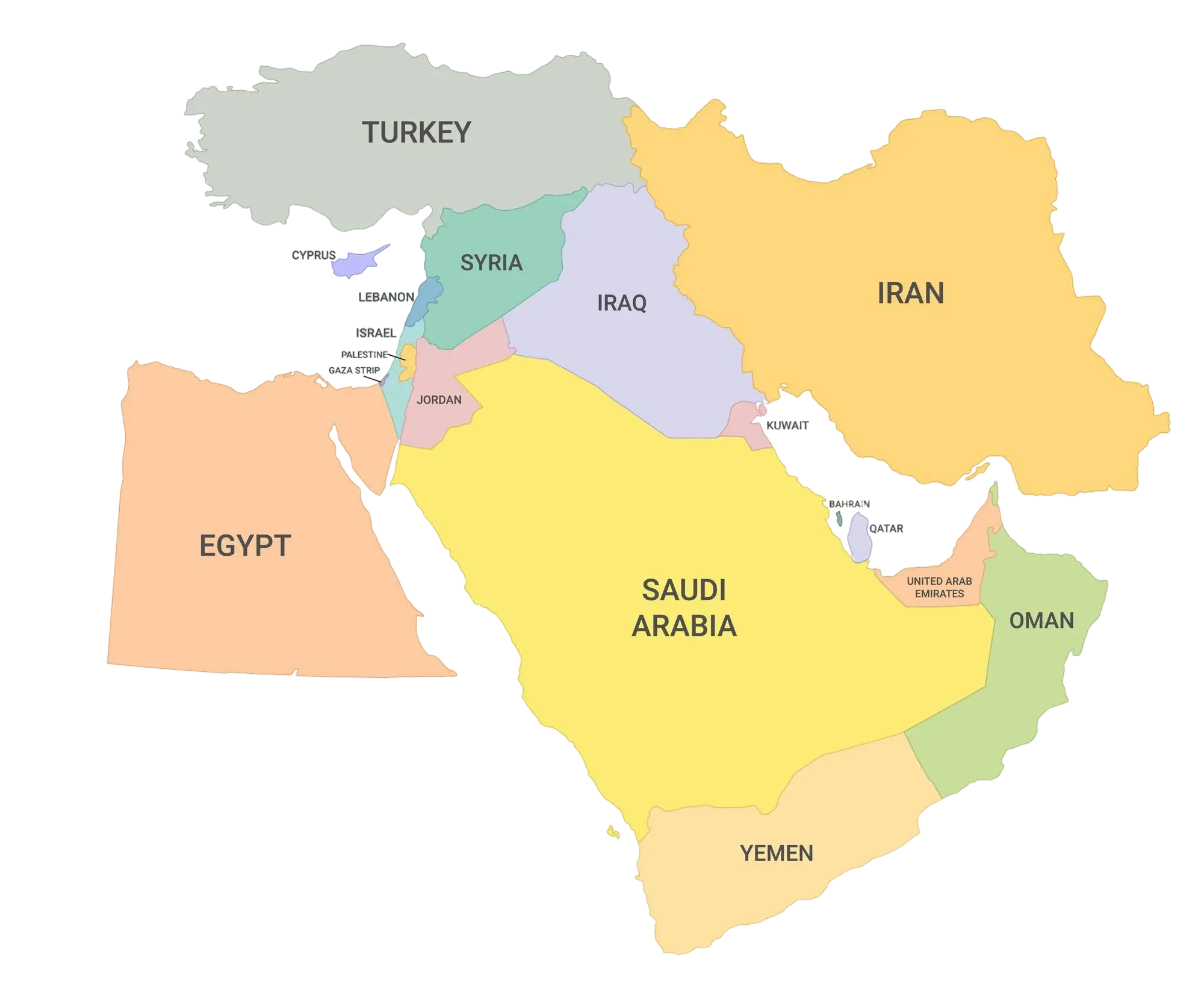
The Middle East is one of the world's fastest-growing eCommerce and logistics regions, driven by aggressive Vision 2030-style investment, geographic positioning between Europe, Asia, and Africa, and rapid digital adoption among young, mobile-first consumers. Whether you're a global brand entering the region, a GCC operation scaling cross-border across the Gulf states, or a manufacturer using UAE or Saudi as a regional hub, finding the right 3PL in the Middle East opens up genuine cost and operational advantages.
The Middle East logistics landscape is anchored by several powerhouse hubs. The United Arab Emirates — particularly Dubai with Jebel Ali Free Zone (JAFZA) and Abu Dhabi with KIZAD — functions as the regional headquarters and re-export capital. Saudi Arabia (Riyadh, Jeddah, Dammam) is the largest GCC consumer market and the focus of massive Vision 2030 logistics investment. Egypt (Cairo, Port Said, Suez) anchors the region's manufacturing economy and Suez Canal trade. Qatar, Kuwait, Bahrain, and Oman round out the GCC, while Jordan serves as the Levant gateway.
With deep parcel networks (Aramex, Fetchr, Barq Express, SMSA, plus DHL/FedEx hubs), dominant marketplaces (Amazon.ae/sa, Noon, Salla, Zid, Carrefour Online), extensive Free Zone infrastructure, and an increasingly sophisticated regulatory environment shaped by GCC-wide VAT and customs union dynamics, the Middle East offers genuine operational depth — with country-specific specifics that reward partners who understand the regional regulatory landscape.
Key factors to evaluate when selecting a warehousing or fulfillment partner across the Middle East.
The Middle East spans diverse markets, so country selection matters more than within other regions. UAE is the default for regional HQ functions, re-export, and free-zone-based operations — JAFZA and KIZAD are the dominant clusters. Saudi Arabia is essential for the largest single consumer market; Riyadh hosts the densest 3PL infrastructure with Jeddah and Dammam handling port-led operations. Egypt works for low-cost manufacturing and African market access. Most regional brands run a UAE + Saudi two-node strategy.
Free Zones are central to the regional economics. JAFZA, DAFZA, KIZAD (UAE), King Abdullah Economic City (KSA), and others offer 100% foreign ownership, 0% corporate tax for qualifying activities, full repatriation of capital, and bonded import. UAE warehouse rates run $10–$18/sqft/year in prime Dubai/Abu Dhabi locations; Saudi runs $8–$14; Egypt is significantly cheaper at $3–$6. Labor costs vary dramatically across the region.
VAT rates differ by country: UAE 5%, Bahrain 10%, Saudi Arabia 15%, Oman 5%, Egypt 14%, Qatar and Kuwait have no VAT. The GCC Customs Union enables free movement of goods between UAE, Saudi, Kuwait, Bahrain, Qatar, and Oman with a unified 5% external tariff. Halal certification (SFDA in Saudi, ESMA in UAE) is mandatory for many food and cosmetic categories. A strong regional 3PL handles VAT registration, customs filing, and Free Zone structuring.
Amazon.ae and Amazon.sa dominate marketplace eCommerce alongside Noon (Emaar-backed regional player). Salla and Zid are the leading Saudi DTC platforms. Carrefour Online spans grocery. Operations need to plan around Ramadan (~1 month annually): consumer behavior shifts dramatically (evening order spikes, daytime fulfillment slowdowns), and Eid holidays create predictable shutdowns. Cash on Delivery remains significant in Egypt and parts of the GCC.
The Middle East logistics landscape varies significantly by country. The United Arab Emirates is the default regional HQ choice — Dubai's Jebel Ali Free Zone is the largest in the Middle East, and DAFZA, JAFZA, and DMCC offer specialized clusters for trade, commodities, and tech. Saudi Arabia is the largest consumer market in the region; Riyadh, Jeddah, and Dammam form the three-city manufacturing and distribution backbone, with Vision 2030 driving massive new logistics investment.
Egypt is the region's largest population (~115M) and a growing manufacturing economy, anchored by Cairo and the Suez Canal Economic Zone. Qatar (Doha) and Kuwait are smaller but high-AOV markets focused on premium retail. Bahrain serves as a Gulf financial hub with a smaller logistics footprint.
Oman (Muscat, Salalah, Sohar) plays an increasingly important role with its deepwater ports outside the Strait of Hormuz, providing an alternative routing for global shipping. Jordan (Amman, Aqaba) anchors the Levant and serves as a gateway to Iraq and the broader Levantine trade. Each country offers distinct trade-offs between cost, infrastructure, market size, and regulatory environment.
Key metrics and market data for logistics and fulfillment across the Middle East.
Listed Middle East 3PL, warehousing, and fulfillment providers across the UAE, Saudi Arabia, Egypt, and the wider region.
42 matching directory locations in Middle East. Showing up to 12 profiles, ordered by membership tier with rotation within each tier.
Answers to the most common questions about Middle East warehousing, eCommerce fulfillment, and choosing a 3PL across the region.
Free for brands. No commissions. Your details go only to the 3PLs you match with.
Get matched to 3PLs
The commission-free 3PL directory and matchmaking platform. 5,000+ 3PLs, 200+ verified members, and 3PLs never pay us to be recommended.
3PL, fulfillment, M&A, eCommerce and trade, written by a human. Read by 3,000+ operators and the logistics ecosystem.
Subscribe to Taking Inventory Free. Every two weeks. Unsubscribe any time.